

Why Scanning Your Artwork Beats Photography (And What 600dpi Actually Means)
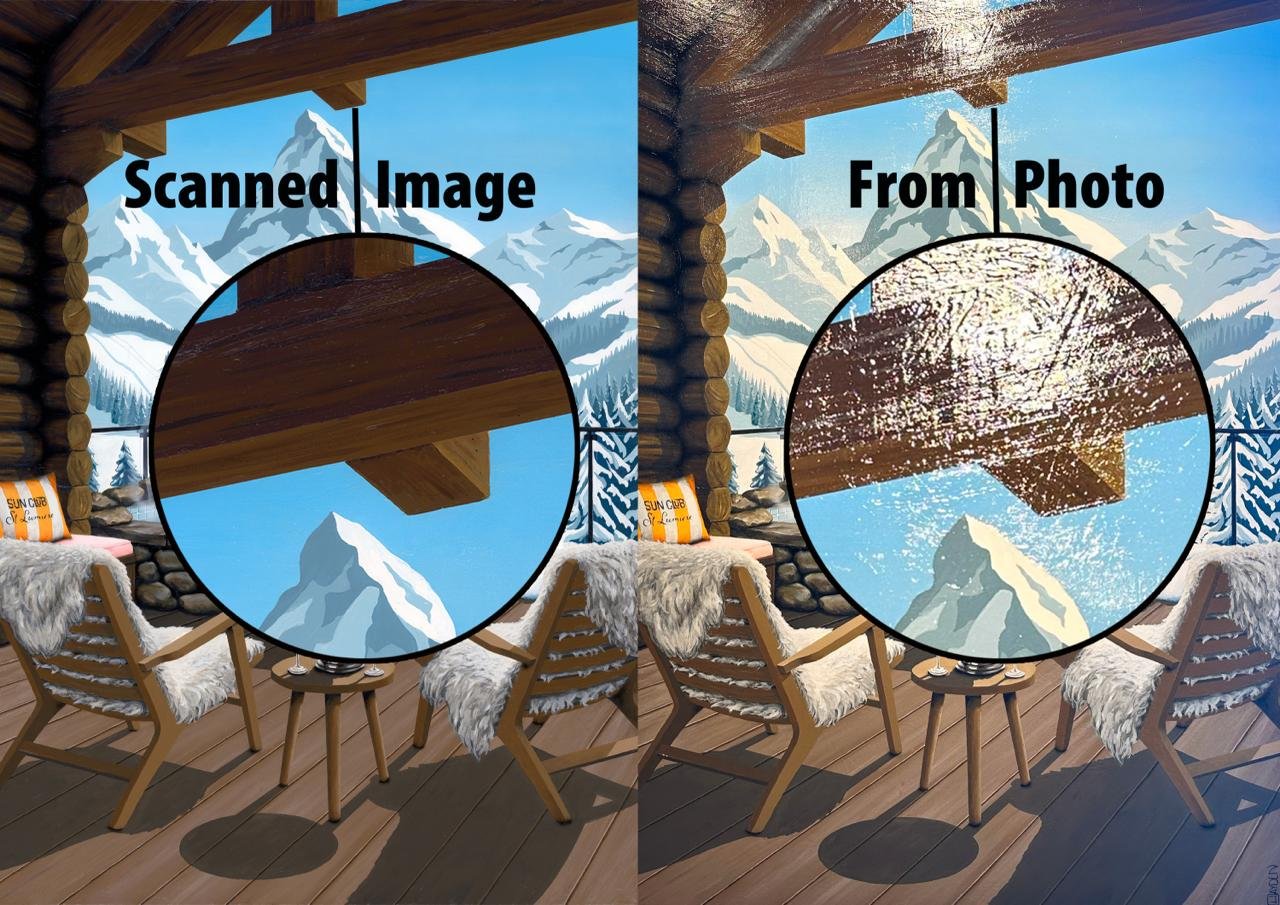
Every artist has done it. You hold your phone above a finished painting, try to get the light right, take twelve photos and still none of them look quite like the real thing. The colours are slightly off. The texture has flattened. The edges are distorted. You upload it anyway because it's good enough for Instagram.
But what happens when good enough isn't good enough?
When you need a file for giclée printing, a gallery catalogue, a licensing deal, an insurance record, or a limited edition release - the difference between a phone photo and a professional archival scan is enormous. Here's why.
THE PROBLEM WITH PHOTOGRAPHING ARTWORK
Photography introduces variables that are almost impossible to eliminate without specialist equipment and expertise:
Lens distortion. Even high-quality camera lenses introduce barrel or pincushion distortion, particularly at the edges of the frame. For rectangular artworks, this means your straight edges curve slightly in the digital file.
Uneven lighting. Getting perfectly even light across a large canvas without hotspots or shadows requires professional lighting rigs. Natural light shifts constantly. Flash creates glare. Most artists work with what they have.
Colour inaccuracy. Camera sensors interpret colour differently to the human eye, and different light sources shift colour temperature dramatically. What looks accurate on your phone screen may print completely wrong.
Focus fall-off. A camera lens focuses on a single plane. For a painting with texture — impasto, raised brushstrokes, thick layers of paint — areas of the artwork that sit at slightly different depths can go subtly out of focus.
The result is a file that approximates your artwork rather than faithfully recording it.
-
WHAT A SCANNER ACTUALLY DOES
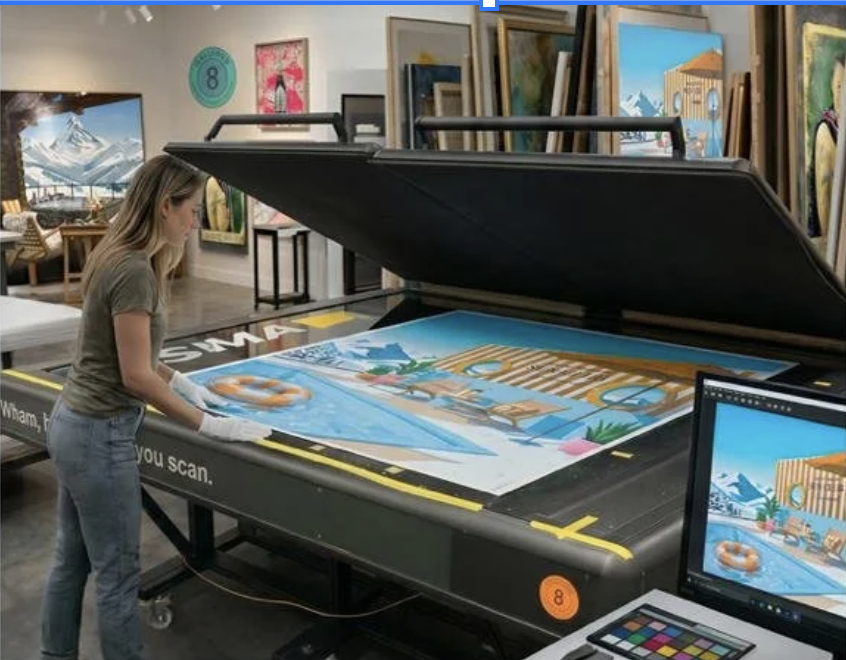
A flatbed scanner doesn't use a lens in the same way. It passes a row of sensors directly across the surface of the artwork at a fixed, consistent distance, capturing the image in strips that are stitched together into a single file. There's no lens distortion. The light source is controlled, even and consistent. The sensors record what's there rather than interpreting it through glass.
At Gallery 8, we use the SMA Versascan 4870 — a large-format scanner capable of capturing originals up to 1219mm × 1778mm at 600dpi resolution.
---
WHAT DOES 600DPI ACTUALLY MEAN?
DPI stands for dots per inch. It describes how many individual pixels of information are captured per inch of your artwork.
At 600dpi, a 50cm × 70cm painting produces a file with approximately 11,811 × 16,535 pixels — or roughly 195 megapixels of image data. That's enough resolution to reproduce the artwork at original size with complete fidelity, or to enlarge it significantly without visible quality loss.
For comparison, a 12-megapixel smartphone photo of the same artwork contains about 4,000 × 3,000 pixels. That's less than 2% of the data captured by a 600dpi scan.
The practical difference: a 600dpi archival scan can produce a gallery-quality giclée print at full size. A phone photo typically degrades visibly above A4.
---
WHEN DO YOU ACTUALLY NEED A PROFESSIONAL SCAN?
Not every artwork needs archival scanning. For social media and basic documentation, a good phone photo is genuinely fine.
You need a professional scan when:
You're producing giclée prints or limited editions. Print buyers expect colour accuracy and detail that a phone photo cannot deliver.
You're submitting to galleries or publications. High-resolution scans are the professional standard for catalogue images and press materials.
You're licensing your artwork. Licensing agreements often require archival-quality files, and a scan gives you a file you can use repeatedly across multiple licenses without degradation.
You're building an artist archive. A 600dpi archival scan is a permanent, high-fidelity record of your work — useful for insurance, estate planning, provenance records and future reproductions.
You're working with a framer or printer who needs exact dimensions. A scan captures the precise size of your artwork; a photo often distorts it.
---
HOW THE PROCESS WORKS AT GALLERY 8
We've kept the process as simple as possible.
Book a 15-minute drop-off appointment online. Bring your artwork, its dimensions, and a note about what you need the file for — that helps us recommend the right service tier.
We condition-check your artwork before scanning and confirm pricing before any work begins. Files are delivered via Google Drive within 1 to 3 business days.
Our three service tiers:
Raw Scan — from $80. Ultra-high-resolution archival file, no editing, you keep full control. Volume pricing for multiple works.
Print Ready Scan — from $130. Archival scan plus professional colour matching, clean-up and an A4 proof print on museum-grade media. Ideal for giclée production and collector editions.
Full Colour Grade — price on request. Gallery-grade colour accuracy for limited editions and high-value collector prints.
We also offer fine art printing and bespoke framing if you want to take your work from scan to finished product in one place.
---
BASED IN SOUTHPORT, GOLD COAST
Gallery 8 is located at 8 Ferry Road, Southport, QLD 4215 — inside our gallery and creative studio space.
We work with artists, galleries, collectors, illustrators, designers, photographers and estates across the Gold Coast, Brisbane and South East Queensland.
If you're not sure which service you need, send us a quick email at info@gallery8.com.au with a photo of your artwork and what you're hoping to do with the scan. We'll point you in the right direction.
Book your artwork scanning drop-off at gallery8.com.au/fine-art-scanning-gold-coast